Half a Day Per Segment. Really.
Ask any utility tunnel contractor where the schedule bleeds, and the answer is almost always the same: fixing and striking formwork in a narrow, deep excavation. The TC-120 pipe gallery trolley, developed by Yancheng Lianggong Formwork Co., Ltd for the booming urban pipe gallery market, attacks that bottleneck directly. The formwork system and the trolley system are connected into one integrated unit — formwork is erected and stripped without any dismantling, just by adjusting the trolley’s spindles and hydraulic lifting system. Under normal site conditions, formwork erection for one standard segment takes about half a day. That single number is what turns a grinding relay of loose panels into a production line.
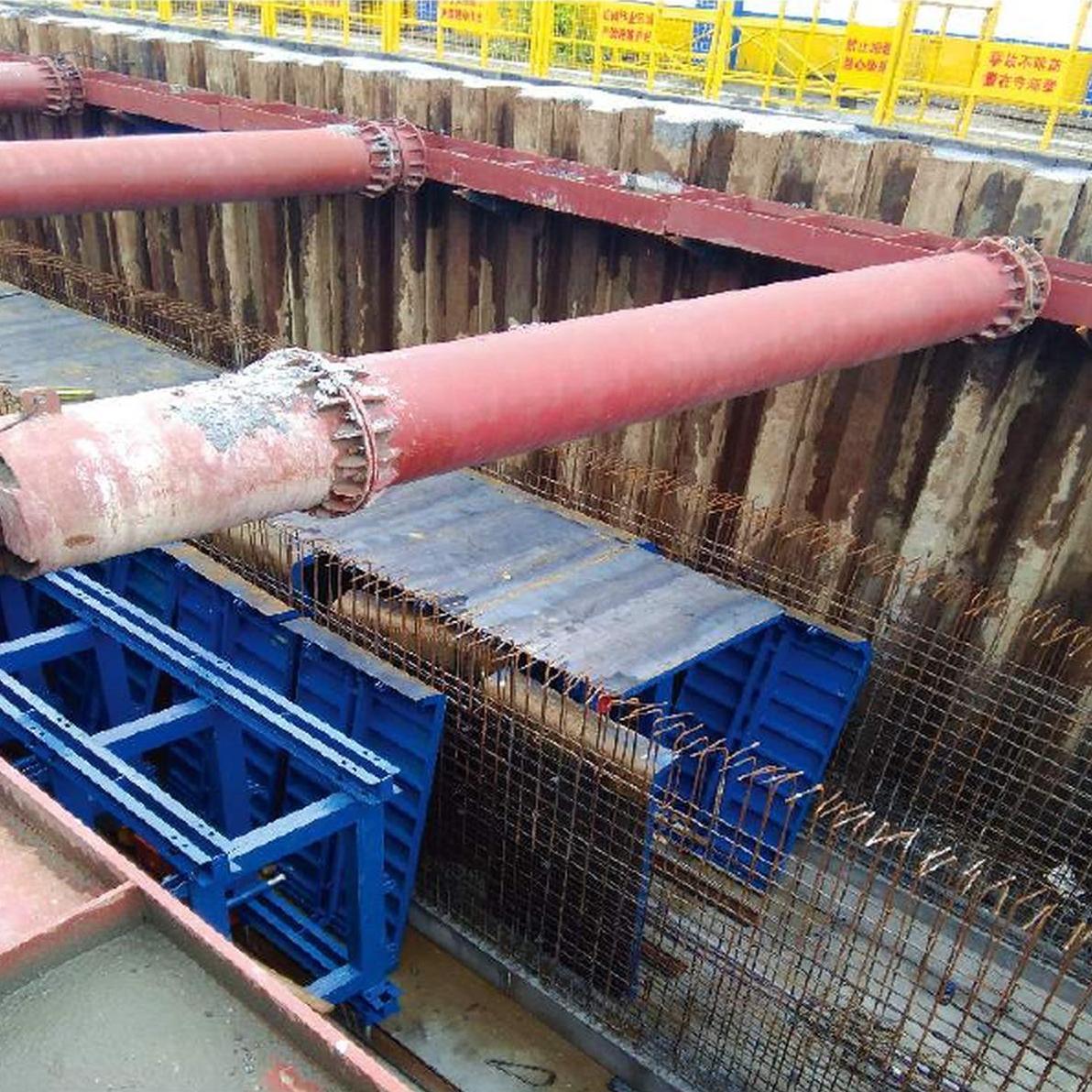
The trolley in service on a pipe gallery project — one integrated steel unit casting segment after segment.
Assemble Once, Reuse for Kilometers
Loose formwork punishes you twice: it is slow to erect and slow to strike, and panels, timbers and clips keep disappearing on a busy site. The TC-120 needs fewer components, which are hard to lose and easy to keep track of, and once assembled it is never taken apart — it just lifts, travels and casts again. Long-term turnover shortens the schedule and cuts labor cost at the same time, and the site stays cleaner because there is no daily pile of loose material to shuffle. The generous space inside the trolley also leaves room for workers to move, and for supervisors and visitors to inspect safely.
Built on a Load Path You Can Trust
Every load the fresh concrete produces is carried by the formwork support system into the trolley gantry, then through the extended adjusting supports into the traveling troughs and the ground. The hydraulic system only lifts — it never carries the pour — so the structure stays rigid and the safety factor stays high. On top of that mechanical simplicity, the operating rules are explicit: concrete poured symmetrically with wall-to-wall level difference within 0.6m, pouring speed controlled to prevent float-up, dedicated spotters during every travel move, trained and certified operators fixed to their posts, and a monthly inspection routine covering members, bolts and pins, circuits, cylinders and hoses, with hydraulic oil renewed every six months. Safety here is not a poster on the wall; it is written into the cycle.
Configure It Around Your Project
No two alignments are the same, so the TC-120 is specified from four building blocks:
| Your situation | Recommended configuration |
| Long alignment, many reuse cycles, heavy pours | Steel panel system: 6mm steel plate, [8 channel secondary joists, double [10 channel main joists |
| Budget-driven, fast mobilization | Timber panel system: 18mm imported WISA board, H20 timber beams, double [12 channel main joists |
| Straight runs, simple logistics | Semi-automatic traveling: winch or other pulling device |
| Many segments, tight scheduling | Fully automatic traveling: electric wheels, forward and backward at the push of a button |
Because the panels and the traveling system are modular, the same platform adapts to different cross-sections and casting rhythms — and if your project mixes in curved sections or shafts, Lianggong also builds customized steel moulds to match non-standard geometry.
What the Numbers Look Like on Site
A standard TC-120 unit runs on four sets of traveling wheels, front and rear pairs sharing one traveling trough. Leveling is done by driving one side at a time; the hydraulic system lifts the formwork to the pouring height, the adjusting supports are extended onto the troughs, and the side formwork is closed to a tolerance of ±5mm per unit. After the pour, curing time is used to prepare the next unit’s wall rebar, so the schedule overlaps instead of waiting. When the concrete reaches strength, the trolley strips, lifts, retracts its supports, travels to the next segment and starts again — ten steps, repeated as many times as your alignment demands. For a closer look at how the same equipment logic performs on other underground works, see Lianggong’s trench excavation and pipe laying solution. Engineers who want the full technical detail — load path, assembly sequence, tolerances and maintenance rules — will find it in the companion guide Pipe Gallery Trolley: Structure, Working Process & Key Specifications.
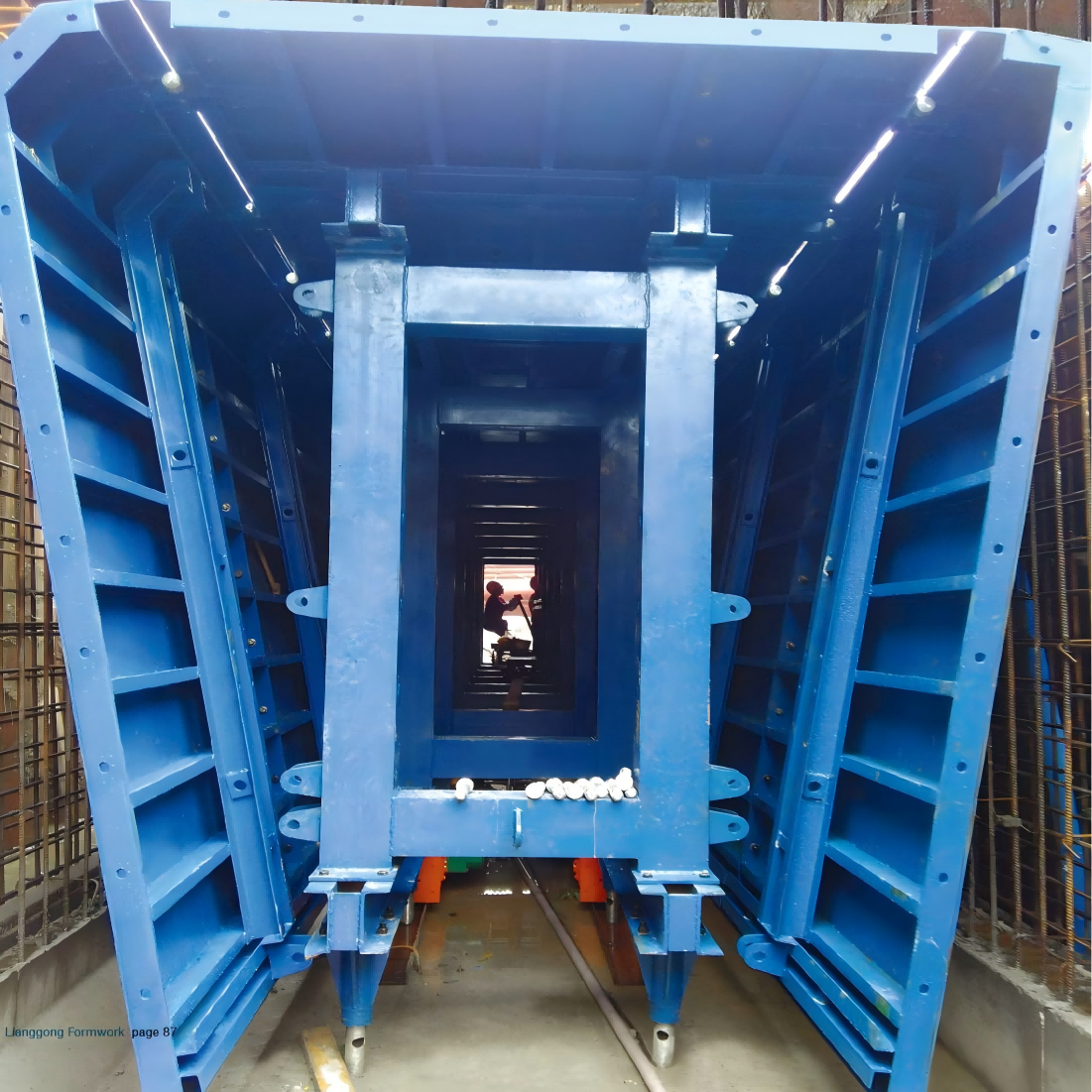
Inside the gallery: the trolley’s side formwork in the erected position, ready for the next pour.
Backed by a Formwork Manufacturer, Not a Trader
Yancheng Lianggong Formwork Co., Ltd is the factory behind the TC-120, operating across engineering, formwork and scaffolding as a solution provider for construction projects worldwide — from tunnel solutions to climbing systems and ringlock scaffolding. Buying from the manufacturer means drawings reviewed by engineers, welding and steel you can audit, spare parts that actually match, and site support that follows the equipment. You can verify the factory and its qualifications on the about us page.
Get a Configuration Proposal
Send your cross-section drawings, segment length and target cycle time, and Lianggong’s engineers will return a TC-120 configuration — panel type, traveling system, gantry spacing — with a quotation. The fastest way is the contact page; the half-day formwork cycle will do the rest of the convincing on site.
Post time: Nov-13-2026